Guides
NACS vs CCS, explained
America's EV world runs on two fast-charging plugs. Here's what they are, which cars use which — and why at HubCharge it doesn't matter.
At the charger
Which cable do I grab?
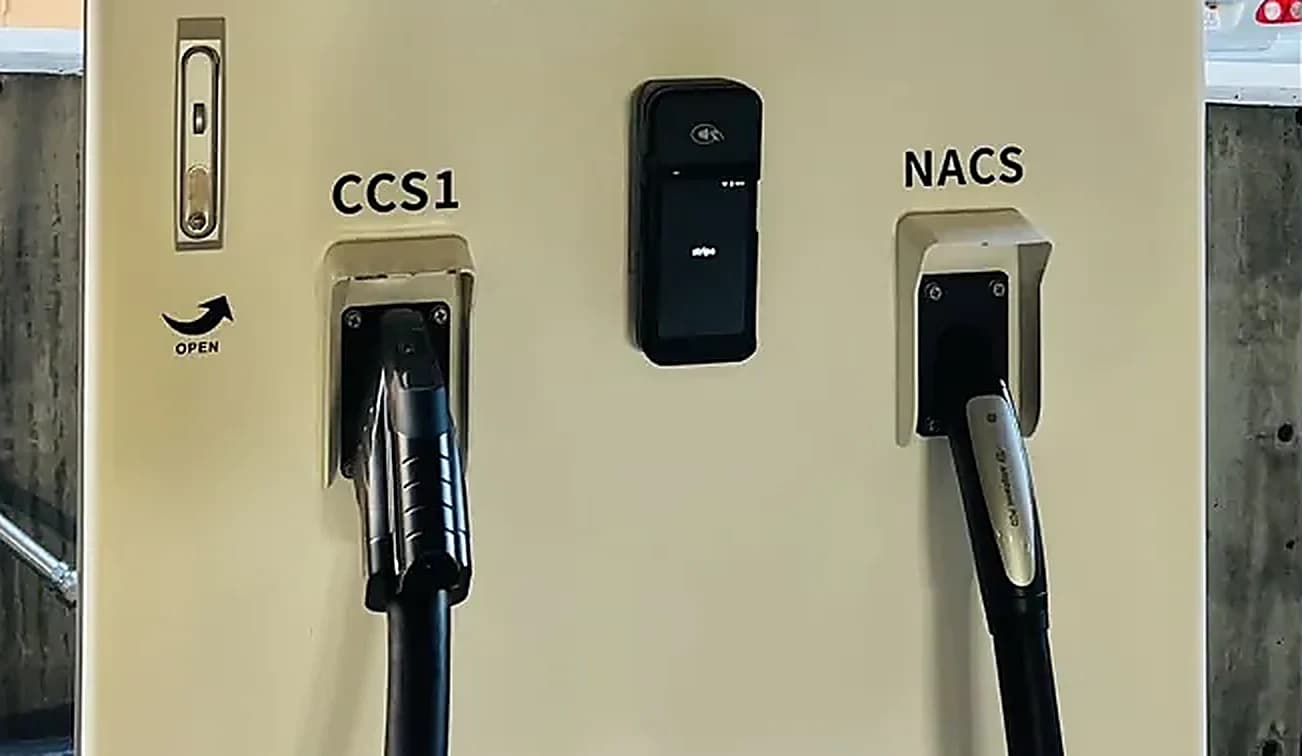
Not sure which you have? Look at the flap on your car, then at the two plugs in the photo — the shapes match. Nissan sit on both sides depending on the model year, so check the car rather than the badge. At staffed hours our attendant does it for you.
Why one is bigger — the pins inside
CCS1
- 2 carry DC — the pair added below the J1772 face
- 3 ground and signalling
- 2 AC pins, unpopulated on a DC cable
Combined Charging System
SAE J1772 Combo
A complete J1772 AC connector — five pins, 43mm across — with two more added underneath for DC. That is what the word Combined means, and why it is so much bigger. It has been the non-Tesla standard here for a decade.
NACS
- 2 carry DC here, and AC at home
- 3 ground and signalling
- no separate AC pins — which is what keeps it small
North American Charging Standard
Tesla connector · SAE J3400
Five pins: three small ones for ground and signalling across the top, and two large ones below that carry AC at home and DC here. Re-using the same two pins for both jobs is what keeps the connector — and the port on your car — this small.
A schematic drawn to relative scale: pin count, size and position follow the published standards, with the J1772 face at 43mm and its pins placed from the specification’s own offsets. It is not a dimensioned engineering drawing. The two dashed wells on CCS1 are the AC pins, drawn empty because a DC cable does not populate them.
Why HubCharge carries both cables
The industry is mid-transition from to , and it will take years. Rather than make you buy a $200+ adapter or hunt for the right charger, every HubCharge charger has both a NACS cable and a CCS cable. You plug in whichever matches your car — or at participating locations, our attendant does it for you.
About adapters (you won’t need one here)
Two different adapters exist, and both get called “the Tesla adapter,” which causes confusion:
- CCS car → NACS charger: lets a CCS-port car (most Fords, VWs, Hondas…) use a NACS-only charger, like a Tesla Supercharger.
- NACS car → CCS charger: lets a Tesla or other NACS-port car use a CCS-only charger.
Adapters matter at single-connector networks. At HubCharge, both cables are on the charger — so leave the adapter in the trunk.
What about ?
CHAdeMO is an older fast-charging standard being phased out industry-wide. We carry CCS1 and NACS only, so a car that fast-charges on CHAdeMO can’t DC fast-charge here. More in our compatibility guide.
Ready to try full-service charging?
Pull up, stay in your car, and let our team handle the rest — no app needed.